How the EVAPORATIVE TANK ™ Works

The EVAPORATIVE TANK ™ is available in four models;
the ET-II and the ET-III are designed to recover chemicals (dragout) from rinse
water.
The ET-II-W and ET-III-W are ideally suited for dewatering spent solutions or
wastewaters that may have a high solids content.
| Pumped solution is circulated
at a high rate from your process tank or reservoir up to the ET-II-W or
ET-III-W and is drained back by gravity to your tank. In the evaporator,
the solution is sprayed onto 700 or 1,000 square feet of evaporative
panels to humidify the blower air that is forced through these panels. The
humid air is then ducted to the outdoors. Heat for evaporation is taken
from the solution pumped through the evaporator(about 9,000 BTU per gallon
of evaporation.) |
|
The
"triple-effect", proprietary mist eliminator reduces any droplet
emissions to a very low level. An optional AirScrubber™ can be installed
inside the EVAPORATIVE TANK™ at any time to further reduce
emissions to meet most stringent regulations.
The ET-III-W or the ET-II-W depends on a high flow rate and large
solution drops suspended in the air stream for its extensive evaporative
surface. The 1/2" passages in the spray nozzles make the ET-III-W
ideal for waste minimization. The ET-II-W is a smaller version of the
ET-III-W and uses a flow rate of 20 to 25gpm.
|
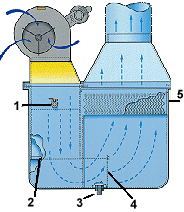
| How The Evaporator Tank™ Works |
- Ball Valve
- Evaporative Panels (ET II & ET III only)
- Drain
- Deflector Panel
- Mist Eliminator
|
 |
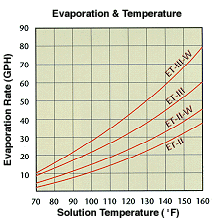
| The chart at right is based
on evaporating pure water at 0% relative humidity, As the impurities in
the water increase, there is less water available to evaporate; your
evaporation rate will decrease. As relative humidity increases, the
evaporation rate of the solution at ambient temperature decreases. As
solution temperature increases, the effect of relative humidity on the
evaporation rate decreases. Temperature does not dictate evaporation rate
... BTU input does (9,000 BTU's or 2.6 KWH per gallon is needed to
maintain solution temp.). This graph shows the maximum evaporation rates
you can expect. Every application is unique, and solutions are not pure
water at 0% relative humidity. Pat. # 4790904 |
 |